Nobody Learns for Free: What Happens to a Course When the Price Drops to Zero?
The follow-up to our price-comparison study completes the picture with a third tier: a completely free course. Anonymized viewing data from 15,048 learners in digital courses from the same college - free, 18 ILS (about $5), and full price in the thousands of shekels - draws one sharp curve: the less you paid, the less you actually learned. And at free? The median enrollee watched zero lessons.
Published: 2026-08-11 · Last updated: 2026-08-11

Edited by Yevgeni Mitrov, co-founder of Wise AcademyResearch & data editor · Updated 2026-08-11
Key findings
Of free-course enrollees never opened a single lesson
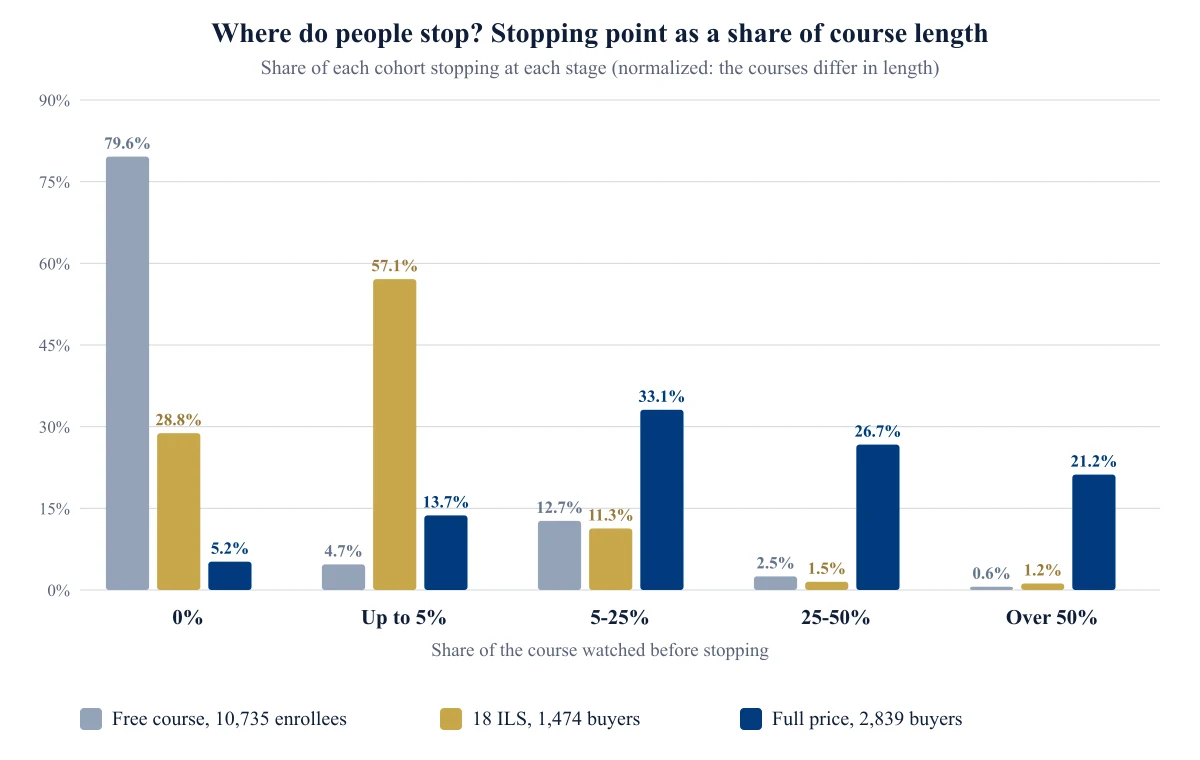
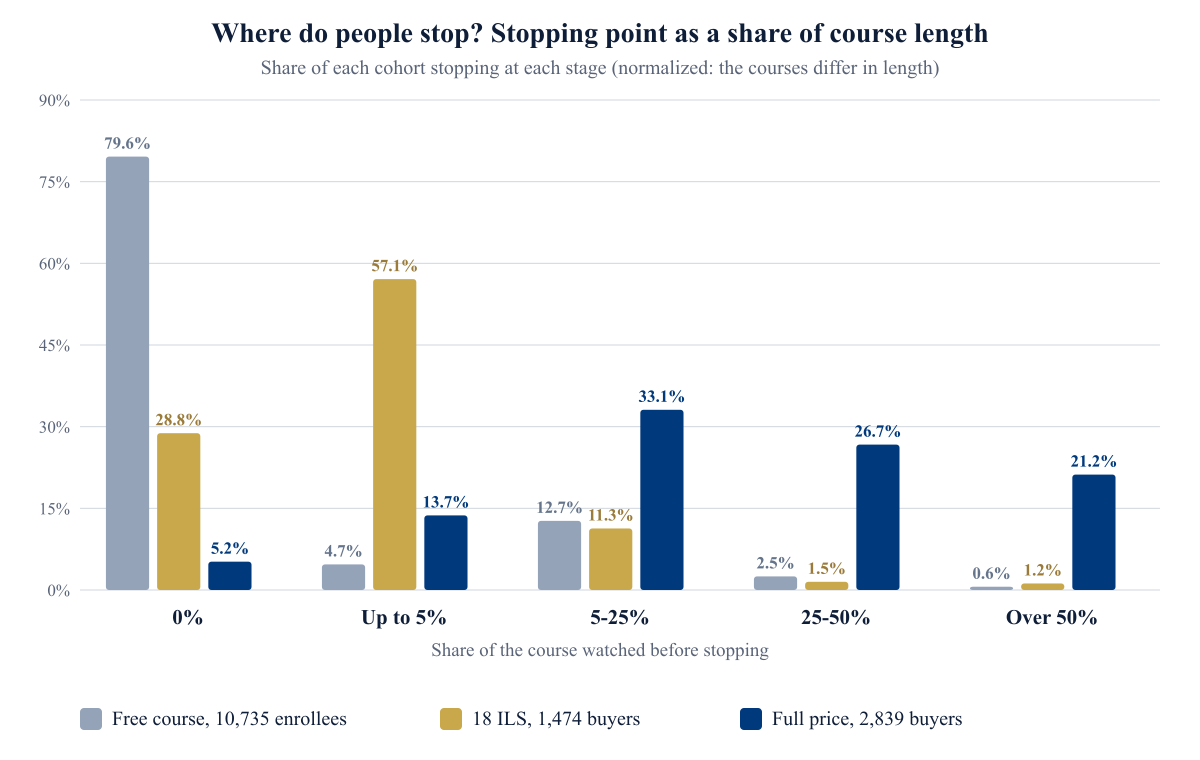
Four out of five people who enrolled in the free intro course never watched even one lesson. Among 18 ILS buyers: 28.8%. Among full-price buyers: just 5.2%.
Lessons watched by the typical free enrollee
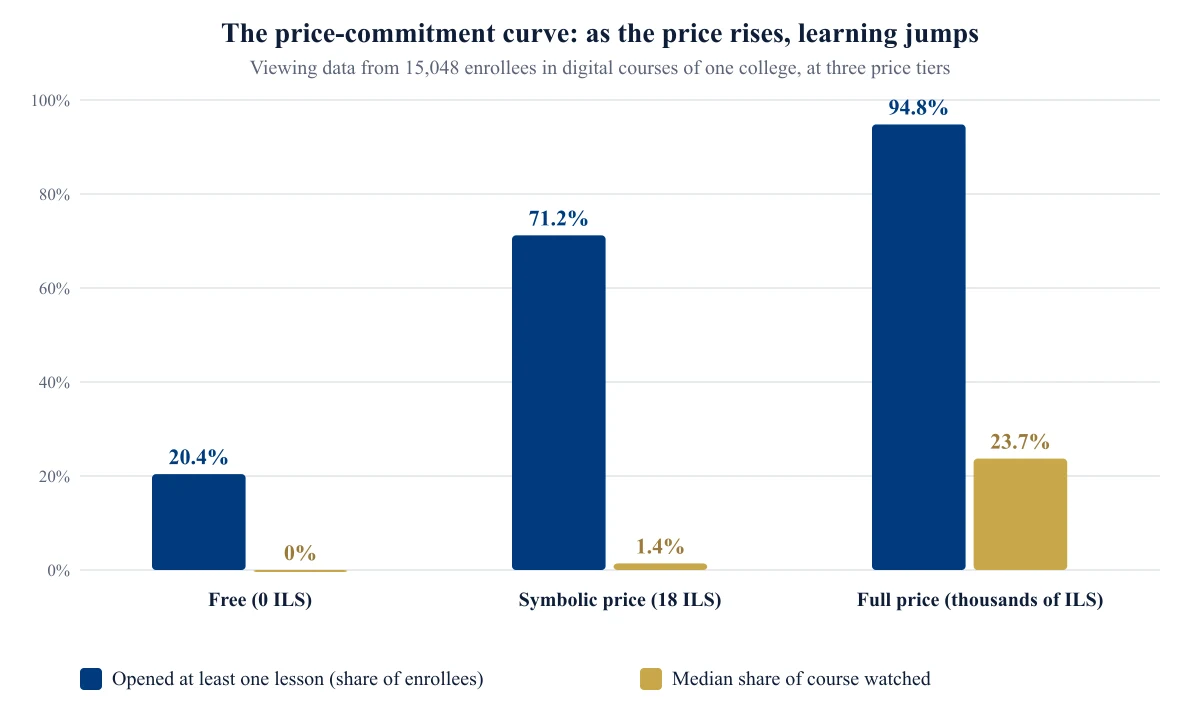
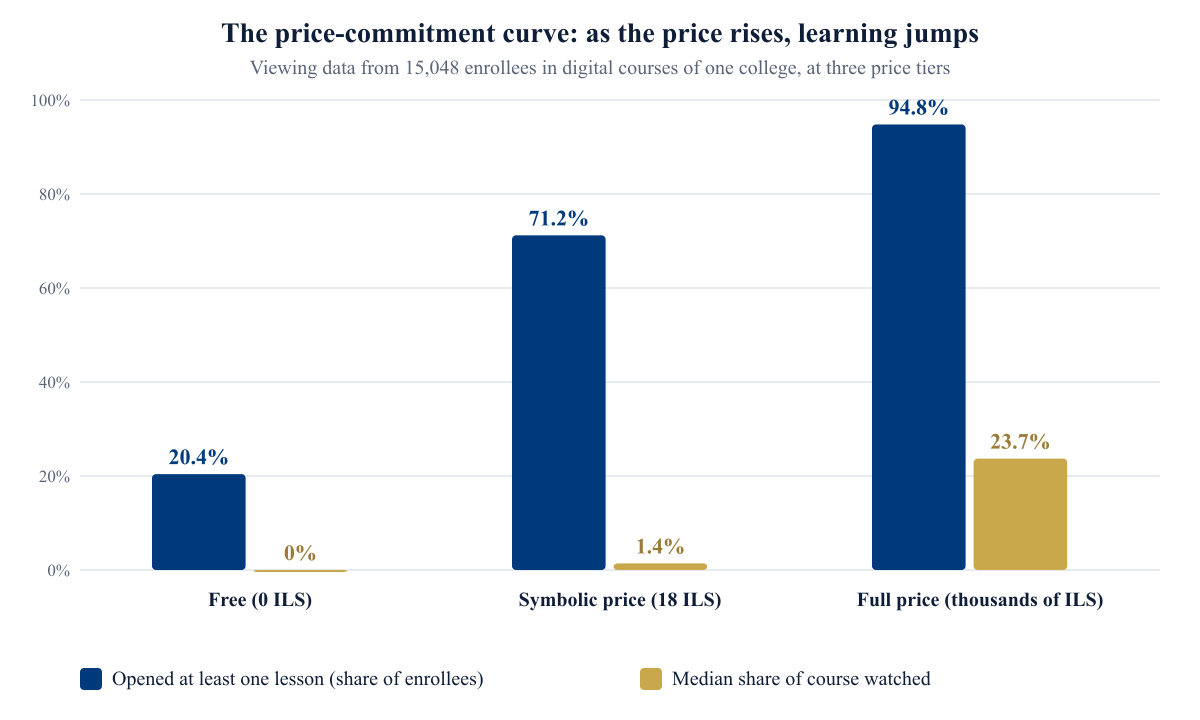
The median free enrollee watched zero lessons. At a symbolic 18 ILS: 2 lessons (1.4% of the course). At full price: 53 lessons (23.7% of the course).
A symbolic payment multiplies the odds of starting
71.2% of 18 ILS buyers opened at least one lesson, versus only 20.4% of free enrollees. Even a near-symbolic payment changes behavior fundamentally - but not enough to make people finish.
Finished the free course - the shortest of the three
The free course has only 26 lessons - more than eight times shorter than the full course. Still, only two enrollees (0.02%) completed it. In the paid courses: zero finishers.
Learners across three price tiers, one institution
The full curve: median viewing of 0% at free, 1.4% at 18 ILS, 23.7% at full price. Price was the strongest predictor of actual learning we found in the data.
Disclosure
Full disclosure: this is viewing data from the digital courses of Wise Academy itself, an Israeli trading and investing college that today teaches in-person only. The free cohort is the college's free intro course; the two paid cohorts come from our previous study of the same comprehensive course (50+ hours) sold once at full price and once at a symbolic 18 ILS. We have a commercial interest in in-person programs, so all numbers are presented as they are, including the unflattering ones (nobody finished the full-price course either). All data is anonymized and aggregate-only. Found an inaccuracy? Write to us and we will correct it with a public note.
Three price tiers, one institution, 15,048 learners
In our previous study we compared the same comprehensive course at two prices - full price in the thousands of shekels versus a symbolic 18 ILS (about $5) - and found a 17x viewing gap. But one question stayed open, maybe the most interesting one: what happens on the last step down, when the price drops to absolute zero?
To answer it, we analyzed the viewing data of 10,735 enrollees in the college's free intro course - a short, accessible digital course of 26 lessons that anyone can join for free - alongside the two purchase cohorts from the previous study. Together: 15,048 learners, three price tiers, one institution, and one learning platform measuring everyone the same way.
The result is a single sharp, unforgiving curve: on every metric we measured - opening a first lesson, median viewing, reaching half the course - actual learning rises steeply with price. Content differences between the courses cannot explain a curve this steep on their own; the people, and the size of the commitment they took on, can.
| Metric | Free course | Symbolic (18 ILS) | Full price |
|---|---|---|---|
| Enrollees in the analysis | 10,735 | 1,474 | 2,839 |
| Course length | 26 lessons | 147 lessons | 224 lessons |
| Never opened a lesson | 79.6% | 28.8% | 5.2% |
| Opened at least one lesson | 20.4% | 71.2% | 94.8% |
| Median share of course watched | 0% | 1.4% | 23.7% |
| Passed half the course | 0.6% | 1.2% | 21.2% |
| Finished 100% | 2 (0.02%) | 0 | 0 |
The price-commitment curve: every dollar buys persistence
The two core metrics tell the same story from two directions. The start metric - how many enrollees opened at least one lesson - climbs from 20.4% at free to 71.2% at 18 ILS to 94.8% at full price. Median viewing climbs from 0% at free to 1.4% at 18 ILS to 23.7% at full price.
Note that the curve is not linear: the biggest jump in the start metric happens between free and 18 ILS, a nearly symbolic payment, while the biggest jump in learning depth happens between 18 ILS and full price. In other words: paying anything makes people open the course; paying something substantial (and the deliberate process that comes with it) makes them learn it.
The shortest course with the lowest completion
You might expect a short course to be finished more often: the free intro course is only 26 lessons - more than five times shorter than the 147-lesson version and more than eight times shorter than the 224-lesson one. Finishing it is incomparably easier. And yet, only 2 out of 10,735 enrollees - 0.02% - completed it.
The stopping-point distribution, normalized to share of course length so courses of different lengths can be compared, shows how extreme the pattern is: 79.6% of free enrollees never started at all, and another 4.7% stopped within the first 5% of the course. Only 0.6% crossed the halfway mark - versus 21.2% of full-price buyers, whose course is more than eight times longer.
Even 18 ILS is not free: the power of a symbolic payment
The most practical finding of the study hides in the middle tier: a payment of 18 ILS, about the price of a sandwich, multiplied the odds that an enrollee would open the course at all by 3.5 (71.2% versus 20.4%). Something in the act of paying, however small, changes the relationship with the product: what cost money gets attention; what is free gets postponed to a "someday" that rarely comes.
But it is just as important to see what a symbolic payment did not do: it did not create deep learning. The median viewing of 18 ILS buyers stayed at 1.4% of the course, and none of them finished. The symbolic payment made people open the door - it did not make them walk in. Only the combination of a substantial price with a serious enrollment process did that, as the previous study showed.
The 'haven't gotten to it yet' myth, free edition
As in the previous study, we tested the obvious objection: maybe the enrollees just haven't gotten around to it? We split the free-course enrollees by enrollment month, from veterans who joined five months ago to the newest joiners. The median viewing is identical in every tenure group: zero. Even people who have had the course open to them for almost half a year never started.
This replicates exactly what we saw in the 18 ILS cohort, where the median stayed at 2 lessons even among buyers with nearly a year of access. Time does not solve the starting problem - it cements it: whoever does not open the course within the first few days almost never opens it at all.
What this means about free, about price, and about real learning
The conclusion is not "never learn for free" - quality free content is an excellent way to sample a field and check fit. The precise conclusion is: free access to content is not learning. Across 15,048 learners at three price tiers, the variable that best predicted whether a person would actually learn was not content quality, course length or available time - it was the size of the commitment they took on upfront.
These findings are consistent with the large-scale MOOC study published in Science, which found completion rates of about 3% in open online courses - but our data adds what edX cannot: one institution, one measurement system, and three price tiers side by side. For the practical takeaway, whether you are a learner choosing how to study or an educator deciding how to price: the price is part of the product. Commitment devices - real payment, fixed sessions, people expecting you - are not the enemy of access; they are what turns access into learning.
Methodology
Data source
An anonymized export from the college's learning management system: one aggregate viewing record per enrollee (lessons watched out of total lessons, join date, status). Global benchmark: The MOOC Pivot, Science 2019. No personal data entered the published analysis - aggregates only.
Sample
15,048 learners in three cohorts: 10,735 enrollees in the free intro course (26 lessons), 1,474 buyers of the comprehensive course at a symbolic 18 ILS (147 lessons), and 2,839 buyers at full price (224 lessons). Removed records and sign-ups without actual access were excluded from all cohorts - the same cleaning rules as the previous study.
Collection period
Free course: enrollments March - August 2026. Symbolic price: purchases September 2025 - March 2026 (plus a handful of later records). Full price: purchases late 2021 - 2023. Data extracted and analyzed on 11 August 2026.
Calculation method
The courses differ in length (26 / 147 / 224 lessons), so all comparisons use share of course length: lessons watched divided by total course lessons. Medians rather than means, to neutralize outliers. "Starting" means watching at least one lesson. The two paid cohorts were re-derived from the original export and match the previously published numbers exactly.
Limitations
- The three courses differ in content, length and depth - the free course is a short intro course. Comparisons are normalized to share-of-course, but note that finishing the free course is much easier, which makes the near-zero completion finding stronger, not weaker.
- Correlation, not causation: a higher price both pre-selects committed enrollees and creates psychological commitment - the data cannot separate the mechanisms.
- Enrollment in the free course happens through a simple sign-up form, so "never opened a lesson" includes people who registered and never logged in - the standard definition of "never started" in the MOOC research we benchmark against.
- The free cohort enrolled within the last five months only (the course is new), a shorter tenure than the paid cohorts. The tenure check above (median zero in every enrollment month, including the oldest) softens this limitation but does not remove it.
- The export contains lesson counts only - no viewing timestamps, no within-lesson minutes, and no outcome measure (trading success). The study measures learning behavior, not its results.
How to cite this data
Free to use by journalists, researchers and bloggers - with attribution and a link to the source.
According to a study by Wise Academy, an Israeli trading and investing college, which analyzed anonymized viewing data of 15,048 learners in digital courses at three price tiers, 79.6% of enrollees in a free course never opened a single lesson and their median viewing was 0%, versus 1.4% of the course among buyers at a symbolic 18 ILS (about $5) and 23.7% among full-price buyers. A symbolic payment multiplied the odds of starting the course by 3.5.
Source: wiseacademy.co.il/en/research/free-vs-paid-course-engagement (published: August 2026)
Update history
- 11 Aug 2026: Precision pass after an external data audit: the full-price purchase window was corrected to late 2021 - 2023, and several phrasings were tightened. All statistics were independently re-derived from the raw exports and confirmed unchanged.
- 11 Aug 2026: English edition published alongside the Hebrew original. Free-course data extracted 11 Aug 2026; both paid cohorts were re-derived from the original export and verified against the previously published numbers (full match).
Frequently asked questions
Do people actually learn from free online courses?▼
In our data, almost never: 79.6% of 10,735 enrollees in the free course never opened a single lesson, and the median enrollee watched zero. Only 0.6% crossed the halfway mark, even though this was a short 26-lesson intro course.
What percentage of people finish a free online course?▼
Our course completion statistics: 2 out of 10,735 enrollees (0.02%) finished the free course. That is lower even than the global MOOC benchmark of about 3% completion found on edX (Science, 2019) - despite our free course being especially short.
Does charging a small price for a course increase completion?▼
It dramatically increases start rates: a symbolic 18 ILS (about $5) made enrollees 3.5 times more likely to open the course (71.2% versus 20.4% at free). But it did not create deep learning: median viewing stayed at 1.4% and nobody finished. A small price solves the starting problem, not the persistence problem.
Why do people not finish courses even when they are free?▼
Because the barrier is not the price of access but the absence of commitment. In our data, the more a person invested upfront, the more likely they were to actually learn - and people who got access for free postponed learning to a "someday" that almost never came: median viewing stayed at zero even among enrollees with five months of tenure.
Can I cite this data?▼
Yes. Citation is free with attribution to Wise Academy and a link to this page. A ready-made citation is in the "How to cite" box above, and we answer journalist and researcher inquiries by email.
Journalists & researchers
For questions about the data, a deeper breakdown, or an expert comment from Yevgeni Mitrov, write to service@wiseacademy.co.il. We answer in English.