How Many People Actually Finish an Online Course?
A rare natural experiment: the same comprehensive trading and investing course (50+ hours of content) was sold in two eras - once at full price (thousands of shekels) and once at a symbolic 18 ILS (about $5) as a learning experiment. The anonymized viewing data of all 4,313 buyers reveals what predicts whether people learn, where everyone quits, and why nobody - literally nobody - reached the end.
Published: 2026-08-11 · Last updated: 2026-08-11

Edited by Yevgeni Mitrov, co-founder of Wise AcademyResearch & data editor · Updated 2026-08-11
Key findings
The engagement gap between full price and symbolic price
Full-price buyers watched a median of 23.7% of the course. Buyers of the same course at a symbolic 18 ILS (about $5) watched a median of 1.4%. The main difference between the groups: how much they paid.
Buyers who finished the course
Not one buyer, in either cohort, in any period, watched 100% of the lessons. Even in the full-price cohort, only 5.8% passed the 75% mark.
Of symbolic-price buyers never opened a single lesson
Almost a third of the people who paid real money for a course never watched even one lesson. In the full-price cohort: only 5.2%.
Of symbolic-price buyers stopped by lesson 5
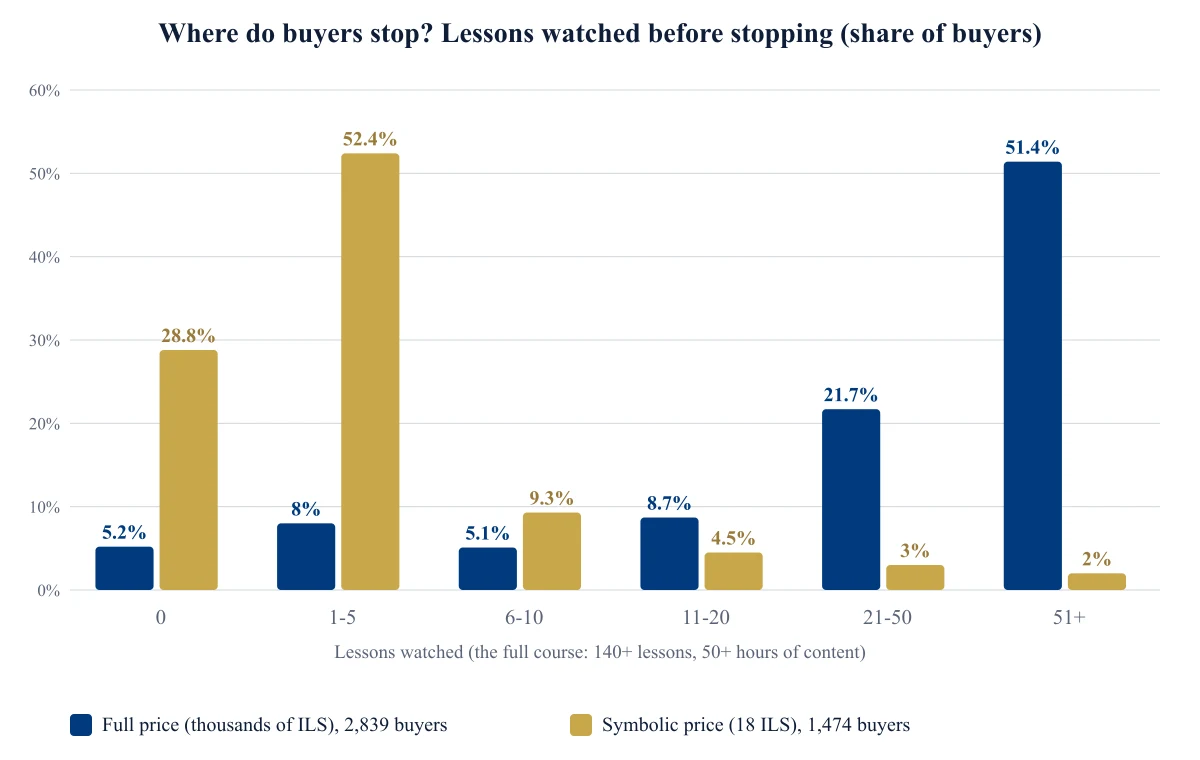
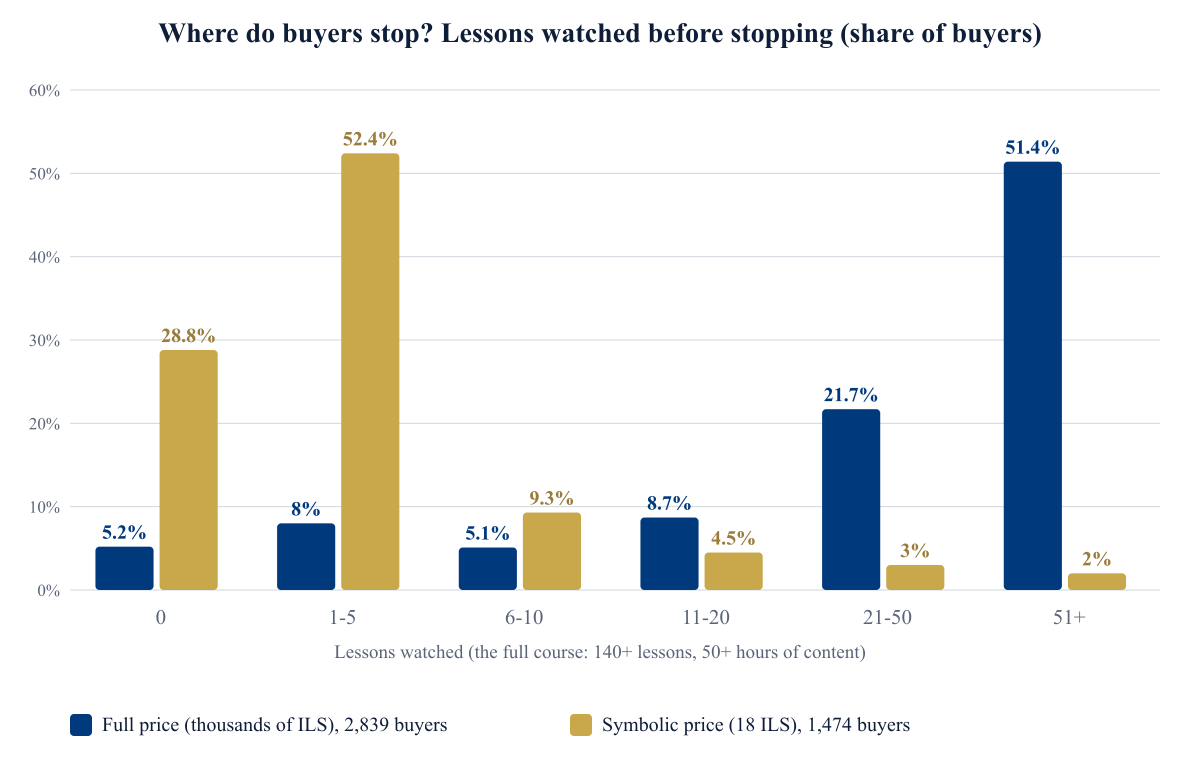
Out of more than 140 lessons, 81.2% of the 18 ILS buyers stopped within the first five lessons or never started. In the full-price cohort only 13.2% dropped that early, and more than half passed lesson 50.
Lessons watched by the typical symbolic-price buyer
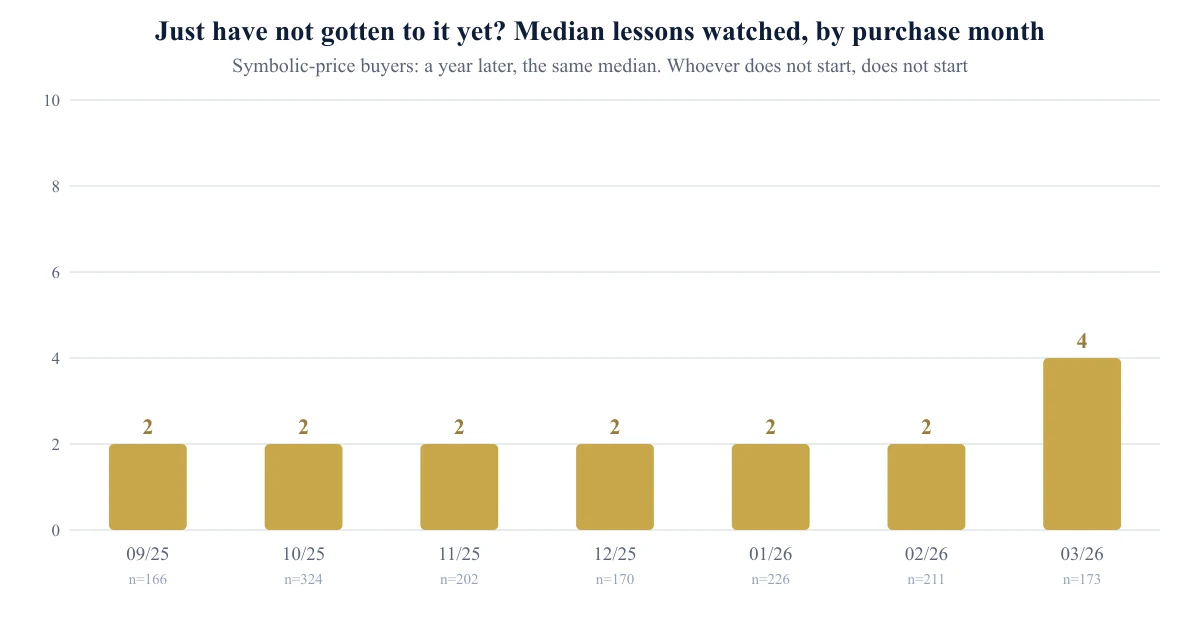
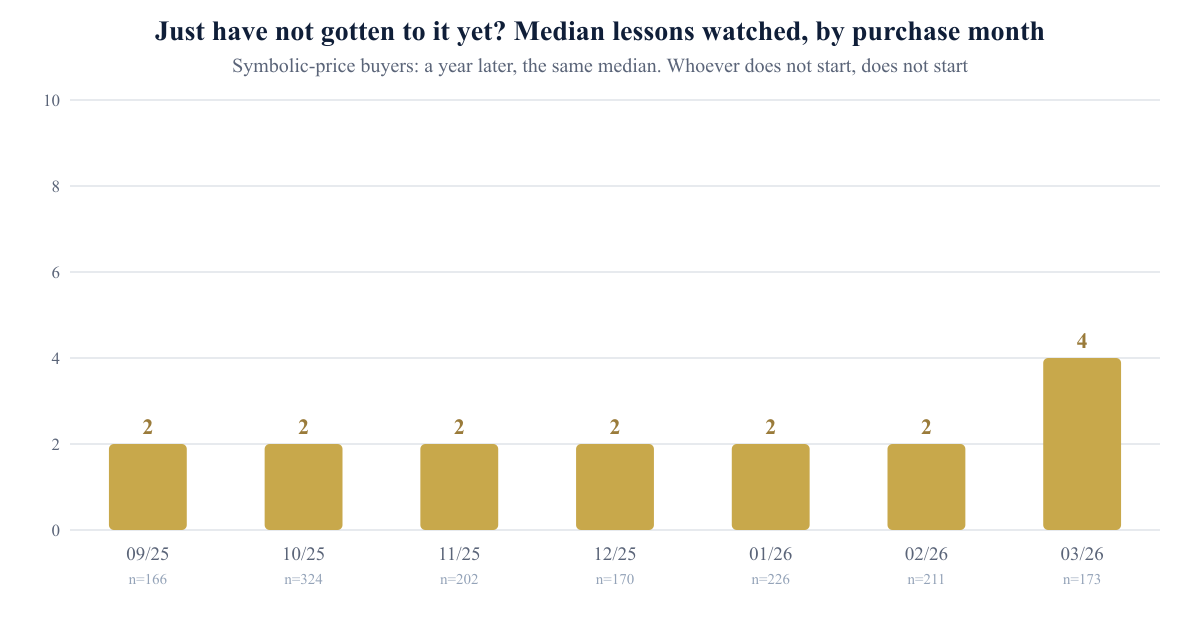
The median symbolic-price buyer watched exactly two lessons. Time did not change that: buyers who had held the course for nearly a year were still at the same median.
Disclosure
Full disclosure: this is the viewing data of buyers of the digital course sold by Wise Academy itself, an Israeli trading and investing college that today teaches in-person only. The college stopped selling digital courses years ago; the course was re-opened for about half a year at a symbolic price as a learning experiment, which is what made this comparison possible. We have a commercial interest in in-person programs, so all numbers are presented as they are, including the ones that do not flatter us (nobody finished the full-price course either). All data is anonymized and aggregate-only. Found an inaccuracy? Write to us and we will correct it with a public note.
The natural experiment: one course, two prices, 4,313 buyers
Between late 2021 and 2023 the college sold a comprehensive digital course on stock markets and digital assets - more than 200 video lessons, over 50 hours of content - at full price (thousands of shekels), through a structured sales process. 2,839 active students bought it that way.
A few years ago the college moved to in-person teaching only and the course was taken off the market. In late 2025 it was re-opened, in an updated version of about 147 lessons, for roughly half a year, at a symbolic 18 ILS (about $5), as a learning experiment. 1,474 people paid and received full access.
The result is what researchers call a natural experiment: essentially the same product and content, from the same institution - and two groups that differ mainly in what they paid and how they arrived. The learning platform records how many lessons each buyer watched, which makes it possible to answer a question everyone asks and almost nobody publishes real data on: how much do people actually learn from an online course?
| Metric | Full price (thousands of ILS) | Symbolic price (18 ILS) |
|---|---|---|
| Buyers in the analysis | 2,839 | 1,474 |
| Purchase period | Late 2021 - 2023 | Late 2025 - early 2026 |
| Never opened a lesson | 5.2% | 28.8% |
| Median share of course watched | 23.7% | 1.4% |
| Passed half the course | 21.2% | 1.2% |
| Passed 75% of the course | 5.8% | 0.4% |
| Finished 100% | 0 | 0 |
Where does everyone stop? The five-lesson cliff
The distribution of stopping points (assuming sequential viewing, which is how the course is built) exposes the sharpest finding of the study: 81.2% of symbolic-price buyers stopped within the first five lessons or never started at all, and 90.5% stopped by lesson ten - out of more than 140 lessons. Abandonment is not a gradual decay; it is a cliff, and the cliff sits right at the start.
Among full-price buyers the picture is inverted: only 13.2% dropped out by lesson five, more than half (51.4%) passed lesson 50, and a quarter crossed lesson 100. Same course, same opening lessons in both versions - a completely different survival curve.
The 'I just haven't gotten to it yet' myth, and the flat line that kills it
The obvious objection is time: maybe the 18 ILS buyers simply haven't gotten around to it? The data rules this out decisively. We split the symbolic-price buyers by purchase month, from September 2025 buyers who had held the course for nearly a year to March 2026 buyers. The median is essentially identical in every group: 2 lessons.
The implication is simple and brutal: watching does not accumulate over time. Whoever does not start learning within the first few days almost never starts later. The decision of whether a course will be watched is made, in practice, in the moment right after the purchase.
What does predict learning? Returning, not intending
Within the 18 ILS cohort, the variable that does separate learners from quitters is the number of returns to the platform (measured through the number of devices/logins registered per account): buyers who logged in from a single device watched a median of zero lessons; those who came back again and again, from several devices over time, watched dozens. Nobody learned in one sitting; learning happened for those who built a habit of returning.
This lines up with what habit research has known for a long time: intention ("I will learn this someday") predicts nothing. The first, second and third return - those predict.
How does this compare globally? The MOOC benchmark
Our findings are not an outlier - they confirm with Israeli data what academic research found at massive scale: "The MOOC Pivot", published in Science in 2019 and covering all edX courses over six years, found a completion rate of just 3.13% among enrollees in 2017-2018 (PubMed abstract), with 52% of enrollees never starting the course at all.
The comparison adds an interesting nuance: our 18 ILS buyers actually "started" more than free MOOC enrollees (71% opened at least one lesson, versus only 48% on edX) - probably because even 18 ILS is a commitment that free is not. But actual completion is similar in both: near zero. A symbolic payment makes people open the course; it does not make them learn it.
We then tested that hypothesis directly in a follow-up study, adding a third tier to the comparison: a completely free course from the same college, with 10,735 enrollees. The results (full study here) are even sharper: 79.6% of free enrollees never opened a single lesson, and their median viewing was zero.
What this means about learning, and about courses
The careful conclusion from the data is not "online courses do not work". It is more precise than that: content alone does not produce learning. The exact same lessons yielded a median of 24% viewing when bought at full price after a serious sales process, and 1.4% when bought on impulse for 18 ILS. Easy come, easy go.
It is also honest to say what the data cannot show: we have no outcome measure (trading success), only a viewing measure. But one thing is logically certain: you cannot succeed because of a course you never watch. For anyone weighing how to learn a complex field, the important question is not only "which course" but "which framework will actually make me persist" - one with commitment, fixed sessions and people who expect you to show up. That, incidentally, is why the college itself moved to in-person teaching only (about the program, in Hebrew).
Methodology
Data source
An anonymized export from the college's learning management system: one aggregate viewing record per buyer (lessons watched out of total lessons, join date, device count). Global benchmark: The MOOC Pivot, Science 2019. No personal data entered the published analysis - aggregates only.
Sample
4,313 buyers after cleaning: 2,839 active students in the full-price cohort (out of 2,984 records; records with a "removed" status were excluded) and 1,474 paying buyers with actual access in the symbolic-price cohort (out of 1,865 records; sign-ups without course access and removed records were excluded).
Collection period
Full-price cohort: purchases late 2021 - 2023 (plus a small number of later account additions). Symbolic-price cohort: purchases September 2025 - March 2026 (plus a handful of later records). Data extracted and analyzed in August 2026.
Calculation method
Core metric: lessons watched out of total course lessons, as a percentage (the versions differ in length - 224 lessons at full price, 147 in the updated version - so comparisons use share-of-course). Medians rather than means, to neutralize outliers. Stopping-point analysis assumes sequential viewing, which is how the course is structured.
Limitations
- Correlation, not causation: a high price both pre-selects serious buyers (a sales process versus an impulse purchase) and creates psychological commitment - the data cannot separate the two mechanisms.
- The cohorts bought in different periods (late 2021 - 2023 versus 2025-2026) and different course versions of different lengths; comparisons are normalized to share-of-course to neutralize the length gap.
- The export contains lesson counts only - no viewing timestamps and no within-lesson minutes; we can measure how much was watched, not when.
- There is no outcome measure (trading or investing success) in the data - the study measures learning behavior, not its results.
- Buyers were people interested in trading and investing; viewing patterns in other fields may differ.
How to cite this data
Free to use by journalists, researchers and bloggers - with attribution and a link to the source.
According to a study by Wise Academy, an Israeli trading and investing college, which analyzed anonymized viewing data of 4,313 buyers of the same comprehensive digital trading course, not a single buyer completed the course; buyers who paid full price (thousands of shekels) watched a median of 23.7% of the course, while buyers of the same course at a symbolic 18 ILS (about $5) watched a median of just 1.4% - a 17x gap.
Source: wiseacademy.co.il/en/research/digital-course-completion-israel (published: August 2026)
Update history
- 11 Aug 2026: Precision pass after an external data audit: the full-price purchase window was corrected to late 2021 - 2023 (previously stated as 2022-2023, while about 15% of the cohort joined in October-December 2021), and the "reached half the course" row (21.7%) was relabeled to the unified "passed half the course" threshold (21.2%) used by the follow-up study - same data, one consistent cutoff.
- 11 Aug 2026: English edition published, mirroring the Hebrew study published 10 Aug 2026 (reliability checks included tenure-effect falsification and cleaning of no-access records). Global benchmark from Science 2019.
Frequently asked questions
What percentage of people finish an online course?▼
In our data: zero. Out of 4,313 buyers of the course, at both price points, nobody watched 100% of the lessons, and even in the full-price cohort only 5.8% passed 75% of the course. This is consistent with global research: completion on edX was about 3% (Science, 2019).
Does paying more for a course make you more likely to finish it?▼
In our data, dramatically so: full-price buyers watched a median of 23.7% of the course, symbolic-price buyers 1.4% (a 17x gap). Note this is a correlation: a high price both filters for committed buyers and creates commitment - both mechanisms probably act together.
Where do most people stop watching an online course?▼
Right at the start. In the symbolic-price cohort, 81% stopped within the first five lessons or never started, and 90% stopped by lesson ten out of more than 140. Abandonment is not gradual erosion but a cliff at the opening of the course - and whoever does not start within the first few days almost never starts later.
Is this data representative of all online courses?▼
The study covers one comprehensive course (50+ hours) in trading and investing, across two sales eras of the same college - which is exactly what makes it a clean natural experiment, but also limits generalization. That said, the findings closely match global MOOC research on millions of learners. All limitations are detailed in the methodology section.
Can I cite this data?▼
Yes. Citation is free with attribution to Wise Academy and a link to this page. A ready-made citation is in the "How to cite" box above, and we answer journalist and researcher inquiries by email.
Journalists & researchers
For questions about the data, a deeper breakdown, or an expert comment from Yevgeni Mitrov, write to service@wiseacademy.co.il. We answer in English.